How we work
We design the workflow with the people who run it
A process-specific solution only works if someone inside the operation shapes it. This is how a project moves from a written description to software your team uses every day — and what we need from you along the way.
Five stages
-
01
Understand the operation
We start from your written description, then look at how the process runs today: systems, spreadsheets, paper, and where information gets lost. The first conversation is free.
-
02
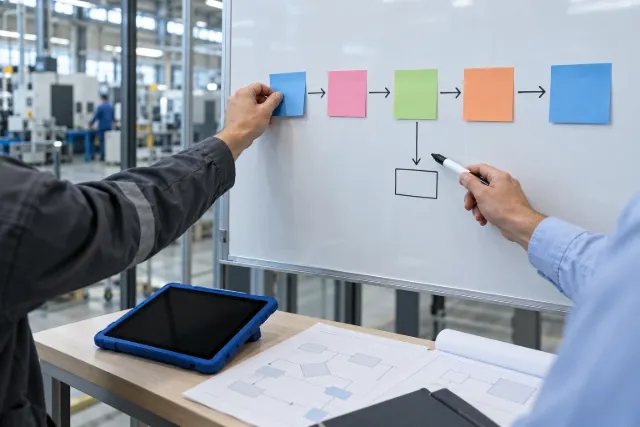
Map and design the workflow together
With your process owner we map stages, roles, the information captured at each step and the exceptions. Screens and flows are designed before any code is written.
-
03
Validate scope, rules and exceptions
Scope, rules, integration approach, price and timeline are agreed in writing before development starts. Acceptance criteria are defined for each stage.
-
04
Implement in controlled stages
We start with the part of the process that matters most and deliver in stages, planned so the operation keeps running. Each stage is tested with real cases and accepted by your process owner before the next one begins.
-
05
Support adoption and continuous improvement
We train the team and follow early use closely, adjusting what real work reveals. After delivery, support, fixes and evolution continue under terms agreed in the contract.
What we need from you
A process owner
Someone who knows the process and can decide rules, exceptions and acceptance. Without that person, a project slows down and delivers the wrong thing.
A concrete, recurring problem
Rework, search time, incidents, delays, missing evidence or training effort — something whose impact you can describe.
Authorized access
Examples, records and, when integration is in scope, access to the systems involved, granted by whoever is responsible for them.
Time to validate
Short reviews at each stage. Acceptance is yours, against criteria agreed in advance.
How we build: an AI-first engineering method
Our engineering process is AI-first: we use AI tools across analysis, development and testing.
That describes how we work. It doesn't mean the software we deliver contains AI, and no AI system makes quality decisions automatically — those stay with your team.
Data, access and continuity
Your data
Operational data belongs to your company. Export in an open format remains available while the system is running.
Backup and recovery
Backup routines and a recovery plan are defined at the start of the project, according to how critical the process is.
Access control
Users, permission levels and an activity log configured to match your organization.
After implementation
Pro9 keeps supporting the system after delivery — adjustments, evolution and support agreed in the contract.
How personal data is handled is defined with your company at the start of each project, considering the data-protection rules that apply to it.
Questions before starting
Do we need to replace our ERP?
No. Your ERP keeps doing what it does well. The solution covers the part of the process it doesn't, and exchanges data with it where that's technically viable.
Can you integrate with our ERP?
It depends on the system. We check what it allows — API, database access, file exchange — and what your vendor contract permits, before proposing anything. That assessment is part of the first stages.
Can we start with a single process?
Yes, and it's the path we prefer: start with the process that causes the most rework, put it into use and evolve from there.
What does it cost?
Each solution is scoped for one process, so the price depends on that scope. The investment is discussed early, before you decide anything, and the proposal states it in writing.
Is there a monthly fee?
It depends on what the project involves: hosting, support and continuous evolution can be a recurring fee. One-time and recurring costs are separate and explicit in the proposal.
Who owns the software?
It's built for your company, and the data is yours. Ownership and usage rights for the code are defined in the contract, agreed before the project starts.
How long does it take?
It depends on the scope. You get the timeline with the proposal, and you see the screen designs before development begins.
Will our team be able to use it?
The workflow follows how your team already works, in the words they already use. We train people closely as part of the rollout.
Start with a written description
Tell us what the process looks like today. We'll reply by email with questions or a suggested next step.
Or write to contato@pro9digital.com